
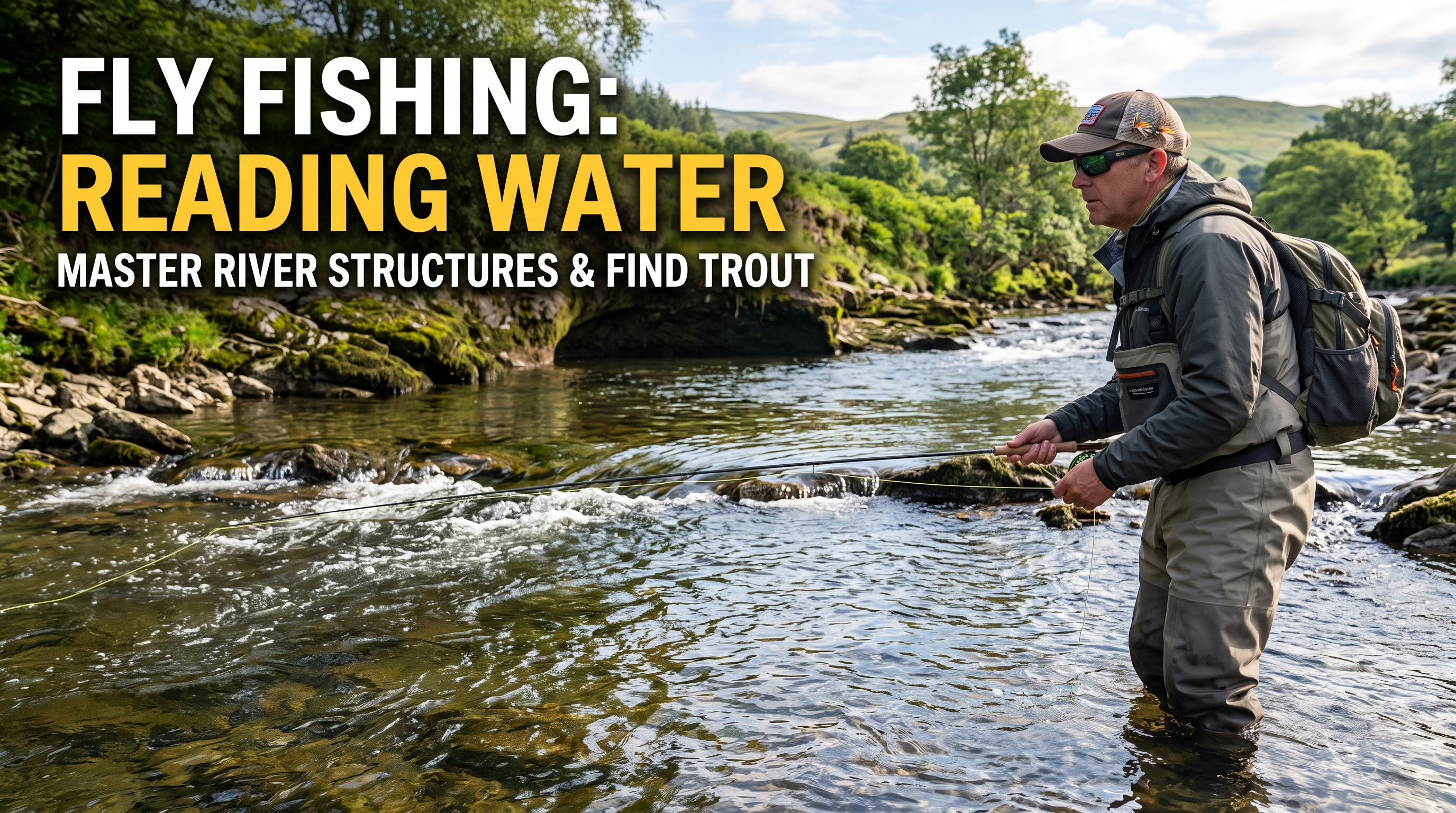
Standing on the bank of a river can feel overwhelming. You have hundreds of yards of moving water in front of you—so where do you actually make your first cast?
Veteran anglers live by a simple rule: 90% of the fish live in 10% of the water.
Trout are driven by energy efficiency: eat as much food as possible while expending the least amount of energy and avoiding predators. Once you learn to look at a river through the eyes of a trout, you stop blindly flailing away at empty water and start casting directly into prime holding spots.
Here is your guide to reading river structures and predicting exactly where trout are hiding.
1. The River Trifecta: Riffles, Runs, and Pools
Every natural trout stream follows a repeating rhythm: Riffle -> Run -> Pool. Understanding how water moves through this sequence is the foundation of reading water.
Riffles (Shallow and Oxygenated)
-
Depth & Current: Shallow (1 to 3 feet), choppy, and fast-moving.
-
Why Trout Are Here: High bug density and high oxygen levels. Trout move into riffles when actively feeding, especially during morning or evening hatches.
-
Best Approach: Use dry-dropper rigs or Euro-nymphing setups with slim tungsten nymphs.
Runs (The Main Dining Room)
-
Depth & Current: Moderate depth (3 to 5 feet), smooth surface, and steady current.
-
Why Trout Are Here: Deep enough to offer protection, steady enough to drift food down like a conveyor belt.
-
Best Approach: Indicator nymphing or floating dry flies with long leaders.
Pools (The Safe House)
-
Depth & Current: Deep (5+ feet), dark, and slow-moving.
-
Why Trout Are Here: Used for resting during extreme summer heat, winter cold, or under bright midday sun.
-
Best Approach: Heavy double-nymph rigs or slow-stripped streamers.
Pro Tip: Focus heavily on the head of the run—the transition point where a shallow riffle dumps into deeper water. This spot offers high oxygen, heavy food supply, and depth safety all in one package.
2. Master the "Seams": The Ultimate Trout Buffet
In river hydraulics, when fast water flows next to slow water, it creates a boundary line called a seam.
Seams are prime targets in fly fishing. The fast current acts as a fast-food conveyor belt carrying aquatic nymphs and flies, while the adjacent slow water allows the trout to hover effortlessly without wasting calories.
How to Fish a Seam:
-
Positioning: Stand in or near the slower water to reduce line drag.
-
Line Control: Cast your fly slightly into the fast side of the seam, allowing it to drift naturally along the boundary line.
-
Gear Tip: To mend line cleanly across conflicting currents without dragging your dry fly, pair a responsive rod like a 9ft 5wt Medium-Fast Fly Rod with a High-Float Weight Forward Fly Line for pinpoint drift control.
3. Pocket Water and Boulders: Hidden Gems in Fast Currents
High-gradient mountain streams are often littered with large boulders. When swift current slams into a rock, it creates micro-habitats called pocket water.
A single boulder creates three distinct holding spots:
-
The Front Cushion: Just upstream of the rock, water pushes back against the obstruction, creating a small, low-pressure bubble where trout sit right in front of the stone.
-
The Behind-Rock Eddy: The classic target. The rock breaks the current, forming a calm pocket of water where food swirls around.
-
The Flank Seams: The narrow lanes of fast water squeezing past the sides of the boulder.
4. Undercut Banks: The Big Fish Fortress
Where currents sweep against the outside bend of a river, the water gradually carves out the dirt beneath the riverbank, creating an undercut bank.
Undercut banks offer three things large trout love most: overhead protection from birds, shade, and fallen terrestrial insects like grasshoppers, ants, and beetles.
Tactical Advice:
-
Keep a low profile on the bank so you do not cast a shadow over the undercut.
-
Cast terrestrial flies like hoppers within 2 to 4 inches of the grassy edge, or slide a weighted streamer underneath the bank overhang.
Summary and Essential Gear
Becoming an expert at reading water is about training your eyes to look for current transitions, depth drops, and physical cover.
Before your next trip, optimize your gear to spot and fish these structures effectively:
-
Polarized Sunglasses: To spot seams and underwater cover, amber or copper polarized lenses cut through surface glare.
-
Precision Nymphs: When targeting deep runs and pocket water, weighted tungsten nymph assortments sink flies quickly into the strike zone.